You may not know this, but we have a strange penchant for optical illusions, fractals, and other mind-perplexing images. That’s why we got so impressed when we saw for the first time the “infinite-zoom” artwork by Nikolaus Baumgarten. Bearing the suitable name “The Zoomquilt”, this seemingly never-ending image instantly became our favorite screen-saver. Take a look at it by clicking the image below, and if you like it, make sure to search YouTube for other similar illustrations.
Strata is a beautiful award-winning game with mesmerizing sound and unique puzzle concept. It contains hundreds of levels with common rules and final goal. Below I present you these rules and ask you to find a universal algorithm, which will allow you to solve easily every single level of the game.
The rules are simple – you begin with an nxn board, some squares of which are colored in arbitrary colors. Then you start placing stripes of whatever color you choose over entire rows and columns of the board. Your task is after placing all available 2n stripes, the color of every (colored) square to match the color of the stripe which has been placed second over it (on top).
Can you find a simple algorithm, which results in solving any level of the game, no matter the starting position? You can watch AppSpy’s video below for better understanding of the rules.
SOLUTION
Imagine the reverse Strata puzzle – the color of every square must match the color of the first stripe which is placed upon it. Clearly, there must be a line in the grid such that all colored squares in it have the same color. Take all such lines in the grid and place on them stripes of appropriate colors. Then erase the colors from all squares covered by the stripes and repeat the procedure until you place all 2n stripes. It is easy to see that if the reverse Strata puzzle has a solution, then we will find it using this strategy. Finally, in order to solve the original Strata puzzle, just place the stripes in reverse order.
Parable of the Polygons is an interesting analysis of diversity in society, beautifully presented through a series of puzzles, simulations, and many, many colorful squares and triangles. This project, created by Vi Hart and Nicky Case, is short, but very insightful and entertaining. Make sure to check it out by clicking the image below.
52 cards – 2 of clubs to Ace of clubs, 2 of diamonds to Ace of diamonds, 2 of hearts to Ace of hearts, and 2 of spades to Ace of spades – are arranged in a deck. We shuffle them in the following manner:
We take the top card and put in a random place inside the deck.
Once we get to the King of spades and put it somewhere in the deck, we stop.
Show that this method shuffles the deck uniformly, i.e. every permutation has the same chance to appear.
SOLUTION
Notice that at all times the cards below the King of spades are shuffled uniformly. Therefore at the end, after we put the King of spades in a random place inside the deck, the entire shuffle will be uniform as well.
The chances are you have already seen the hundreds of optical illusions we have collected for you on Puzzle Prime, but have you ever encountered any audio illusions? The YouTube channel AsapSCIENCE has created a short video in which they present and explain some of the most famous audio illusions, such as the McGurk effect and the Tritone paradox. Watch their video below and see if you can trust your ears.
Can you construct a convex polyhedron, such that no two of its faces have the same number of edges?
SOLUTION
No, you can not construct such a polyhedron. Assume the opposite and consider its face, which has the largest number of sides, say k. Then the polyhedron contains at least k more faces with different numbers of sides, all less than m. However, this is clearly impossible.
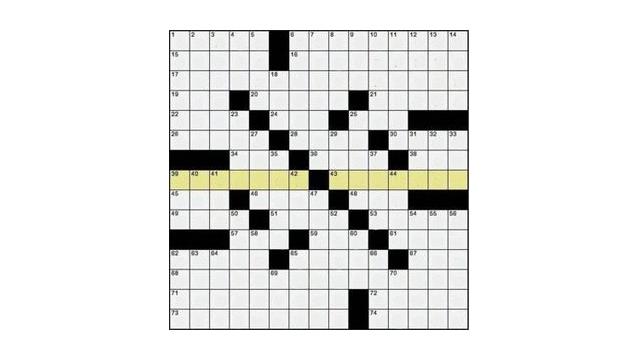
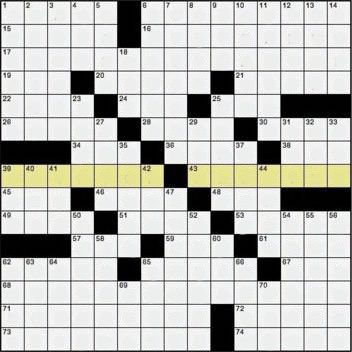
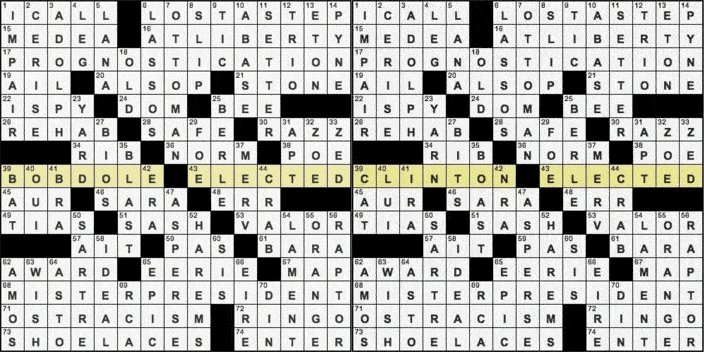
In 1996, just a day before the election of the 40th President of US, the New York Times published a curious crossword. In the 8th row, the solver should discover a phrase – the “lead story of tomorrow’s newspaper”. More precisely – the name of the future President of the country appears there. But how could New York Times know whether it was going to be Clinton or Bob Dole?
ACROSS:
1. “___ your name” (Mamas and Papas lyric) 6. Fell behind slightly 15. Euripides tragedy 16. Free 17. Forecast 19. Be bedridden 20. Journalist Stewart 21. Rosetta ??? 22. 1960s espionage series 24. ___ Perigion 25. Qulting party 26. “Drying out” program 28. Umpire’s call 30. Tease 34. Tease 36. Standard 38. “The Tell-Tale Heart” writer 39. Lead story in tomorrow’s newspaper, with 43A 43. See 39A 45. Gold: Prefix 46. ___ Lee cakes 48. Bobble the ball 49. Spanish aunts 51. Obi 53. Bravery 57. Small island 59. Daddies 61. Theda of 1917’s “Cleopatra” 62. Employee motivator 65. Otherworldly 67. Treasure hunter’s aid 68. Title for 39A next year 71. Exclusion from social events 72. Fab Four name 73. They may get tied up in knots 74. Begin, as a maze
DOWN:
1. Disable 2. Cherry-colored 3. Newspaperman Ochs 4. Easel part 5. Actress Turner 6. Ropes, as dogies 7. Place to put your feet up 8. Underskirt 9. First of three-in-a-row 10. Lower in public estimation 11. Onetime bowling alley employee 12. Threesome 13. English prince’s school 14. ’60s TV talk-show host Joe 18. Superannuated 23. Sewing shop purchase 25. TV’s Uncle Miltie 27. Short writings 29. Opponent 31. Likely 32. Actress Caldwell 33. End of the English alphabet 35. Trumpet 37. Ex-host Griffin 39. Black Halloween animal 40. French 101 word 41. Provider of support, for short 42. Much debated political inits 44. Sourpuss 47. Malign 50. “La Nausee” novelist 52. Sheiks’ cliques 54. Bemoan 55. Popsicle color 56. Bird of prey 58. 10 on a scale of 1 to 10 60. Family girl 62. Famous ___ 63. Something to make on one’s birthday 64. Regarding 65. Quite a story 66. Dublin’s land 69. ___ Victor 70. Hullabaloo
The answer is simple, yet very impressive. The crossword’s author, the mathematics professor Jeremiah Farrell, created the puzzle so that it could be solved in two different ways, revealing either “Clinton Elected” or “Bob Dole Elected” in the middle row. Many of the newspaper’s readers didn’t realize the prank and assumed New York Times was displaying a bias towards one of the candidates. They started sending lots of angry letters and calling the editor, complaining about arguably the coolest crossword of all time.
Which was your favorite part of the Mathematics you learned back in high-school? Not sure about you, but we definitely loved the construction problems, where we had to draw some shape, using just a straightedge and a compass. Even though we haven’t solved such problems for many years, we got very excited to discover the amazing game Euclidea, designed by the guys from HORIS International Ltd. If the description below seems intriguing to you, make sure to visit the game’s website and test your skills by clicking the banner below.
Prove that among any 9 points in (3D) space, there are three which form an obtuse angle.
SOLUTION
Let the points be labeled A1, A2, … , A9, and P be their convex hull. If we assume that all angles among the points are not obtuse, then the interiors of the bodies P + A1, P + A2, … , P + A9 should be all disjoint. That is because, for every Ai and Aj, P must be bound between the planes passing through Ai and Aj which are orthogonal to the segment AiAj. However, all of these 9 bodies have the same volume and are contained in the body P + P, which has 8 times larger volume. This is a contradiction, and therefore our assumption is wrong.