

Never in a Thousand Years
What occurs once in every minute, twice in every moment, but never in a thousand years?
SOLUTION
The answer is THE LETTER M.


We do not know where this puzzle originated from. If you have any information, please let us know via email.
What occurs once in every minute, twice in every moment, but never in a thousand years?
The answer is THE LETTER M.
You are given an 8×8 chess-board, and in each of its cells
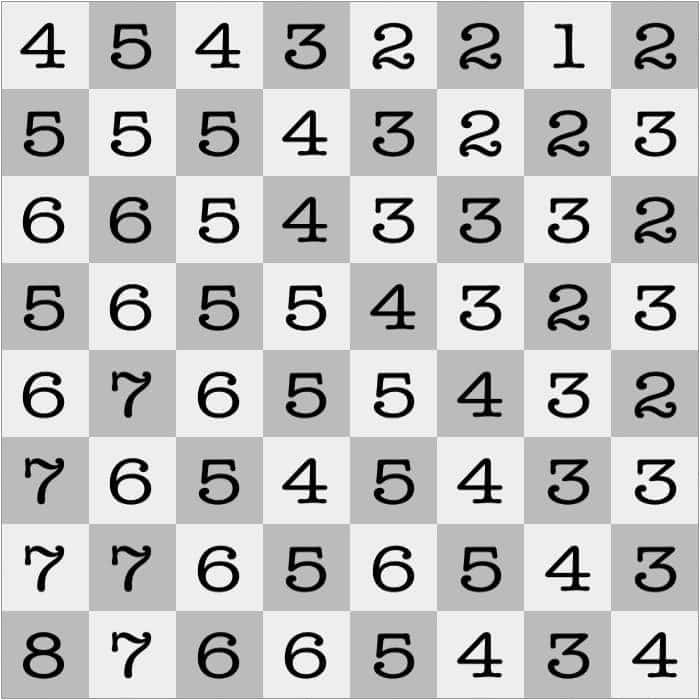
Consider the intervals spanned by the numbers in the first row, second row, third row, etc. If all of these intervals intersect each other, then there is a number, which appears in all of them. If not, there are two intervals, which are disjoint, and a number between them, which does not appear in the two rows. Now it is easy to see that this particular number will appear in every column.
When you need me,
You throw me away.
But when you are done with me,
You bring me back.
What am I?
The answer is ANCHOR.
While changing a tire, a motorist accidentally dropped all four wheel nuts into the sewer grate. Just when the man lost all hope to retrieve the nuts and continue on his way, a kid passed by. After hearing the story, the kid gave an advice, which enabled the driver to successfully fit a new
The kid suggested that the man uses one bolt from each of the other three wheels to fix the fourth one.
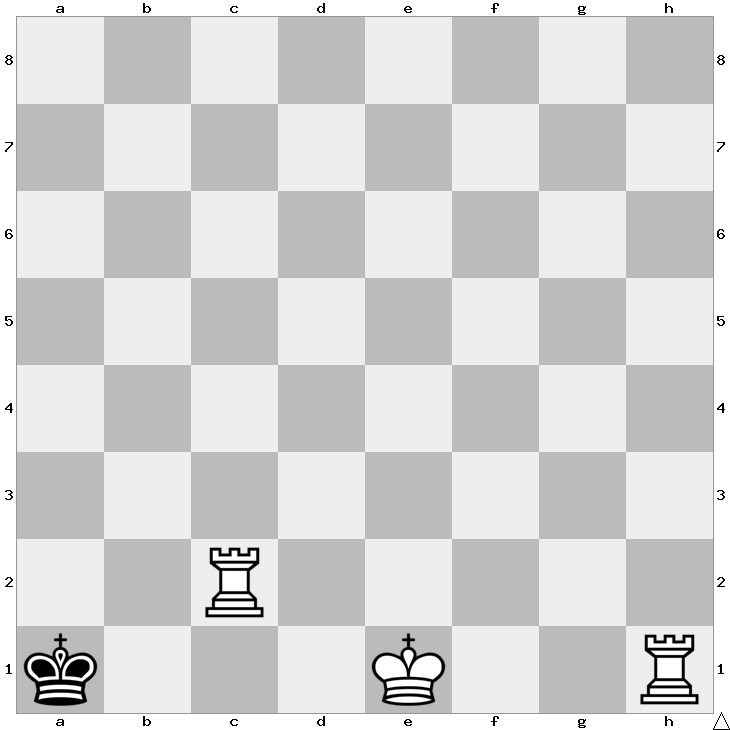
Ned and Jon are playing chess. Eventually, they end up in a position in which Ned (whites) is left with 2 rooks, and Jon (blacks) has just his king on the board. If Ned can mate Jon in exactly 4 different ways, what is the position of the pieces?
Black king on a1, white king on e1, white rooks on c2 and h1. Ned hasn’t moved his king and rook, so he can either castle or move his king to d2, e2 or f2, resulting in a mate.
An old wall clock falls on the ground and breaks into 3 pieces. Describe the pieces, if you know that the sum of the numbers on each of them is the same.
The total of all numbers on the clock is 1 + 2 + … + 12 = 78. Therefore each piece must contain numbers with total sum 26. The only way for this to happen is if the pieces are broken via 3 parallel lines – {1, 2, 11, 12}, {3, 4, 9, 10}, {5, 6, 7, 8}.
One horse traveled for a whole day and at the end
The horse was operating a mill and was traveling in a circle. Thus its outer legs covered larger distance than its inner legs.
Is it possible the following chess position to occur in a game?
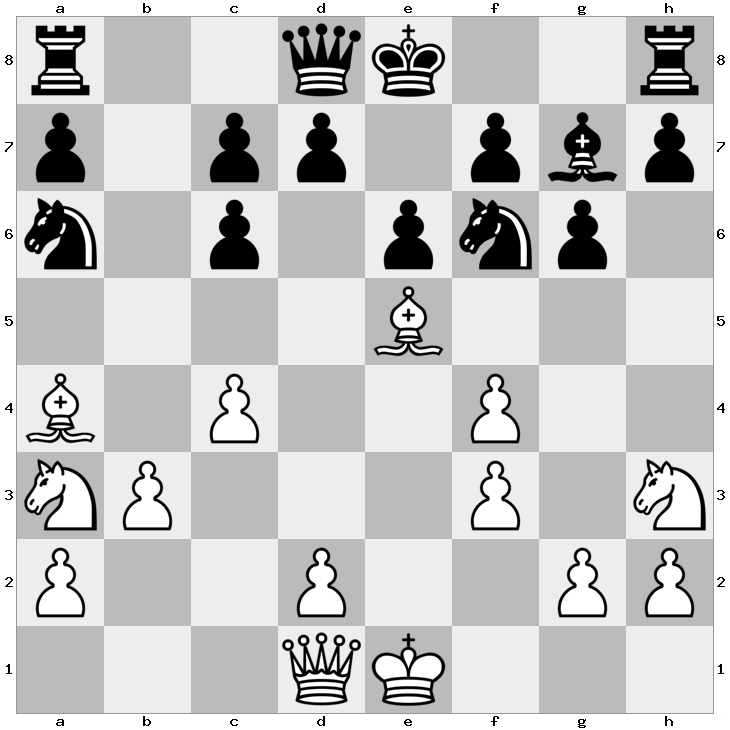
No, it is impossible. The White’s pawn from e2 should have captured the Black’s bishop from c8. In order for the bishop to get there, the pawn on c6 should have captured one of White’s rooks. It couldn’t be the rook from h1, so it should have been the rook from a1. But in order for the rook from a1 to get to c6, the pawns from b2 and c2 should have been moved to b3 and c4 respectively. However, in that case
Alice secretly picks two different integers by an unknown process and puts them in two envelopes. Bob chooses one of the two envelopes randomly (with a fair coin toss) and shows you the number in that envelope. Now you must guess whether the number in the other, closed envelope is larger or smaller than the one you have seen.
Is there a strategy which gives you a better than 50% chance of guessing correctly, no matter what procedure Alice used to pick her numbers?
Choose any strictly decreasing function F on the set of all integers which takes values between 0 and 1. Now, if you see the number X in Bob’s envelope, guess with probability F(X) that this number is smaller. If the two numbers in the envelopes are A and B, then your probability of guessing correctly is equal to:
F(A) * 0.5 + (1 – F(B)) * 0.5 = 0.5 + 0.5 * (F(A) – F(B)) > 50%.
Please confirm you want to block this member.
You will no longer be able to:
Please allow a few minutes for this process to complete.