

Mammals in Cages
You walk into a room where there are three mammals held in cages:
- a trained dog doing tricks
- a monkey playing with blocks
- a lab rat traversing a maze
Which is the most intelligent mammal in the room?
SOLUTION
The answer is… YOU.


We do not know where this puzzle originated from. If you have any information, please let us know via email.
You walk into a room where there are three mammals held in cages:
Which is the most intelligent mammal in the room?
The answer is… YOU.
If:
then BUCK → ?
The answer is CHICKEN.
RABBIT sounds like the noise a FROG makes, OWL sounds like the noise a WOLF makes, BEAR sounds like the noise a SHEEP makes, and MOOSE sounds like the noise a COW makes. Since BUCK sounds like the noise a CHICKEN makes, that’s the answer.
Can you find a triple of three-digit numbers that sum up to 999 and collectively contain all digits from 1 to 9 exactly once? How many such triples are there? What if the sum was 1000?
There are exactly 180 such triples that sum up to 999 and none that sum up to 1000.
In order to see that, notice that the sum of the first digits of the numbers can be no more than 9. Since the sum of all digits is 45, the sum of the middle and the sum of the last digits should be both no more than 9+8+7=24, and no less than 45-9-24=12. We then see that the sum of the last digits should be exactly 19 and the sum of the middle digits should be exactly 18. The sum of the first digits should be 45-19-18=8.
There are 2 ways to get 8 using unique digits from 1 to 9: 1+2+5 and 1+3+4.
Since the set of the first digits, the set of the middle digits, and the set of the last digits of the numbers can be permuted in 6 ways each, we get a total of 5×6×6×6=1080 solutions, or 180 up to permutation of the 3 three-digit numbers.
In order to see that we cannot get a sum of 1000, we note that since the sum of the digits from 1 to 9 is divisible by 9, then the sum of the 3 three-digit numbers should be divisible by 9 as well. Since 1000 is not divisible by 9, the statement follows.
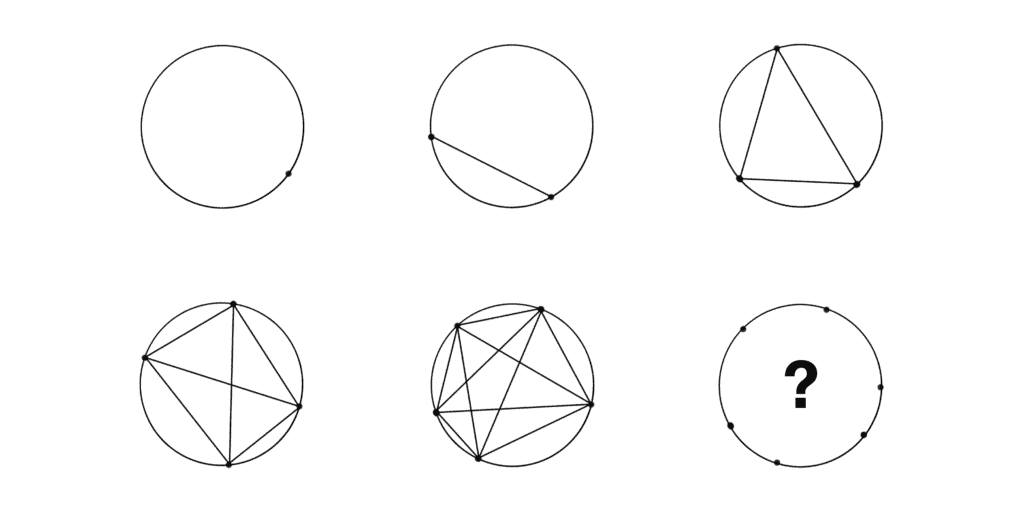
There are N points on a circle. If we draw all the chords connecting these points and no three of them intersect at the same point, in how many parts will the interior of the circle get broken?
For example, when N is equal to 1, 2, 3, 4, and 5, we get 1, 2, 4, 8, and 16 parts respectively.
The answer, somewhat surprisingly, is not 2ᴺ⁻¹, but 1 + N(N-1)/2 + N(N-1)(N-2)(N-3)/24.
In order to see that, we start with a single sector, the interior of the circle, and keep successively drawing chords. Every time we draw a new chord, we increase the number of parts by 1 and then add 1 extra part for each intersection with previously drawn chords.
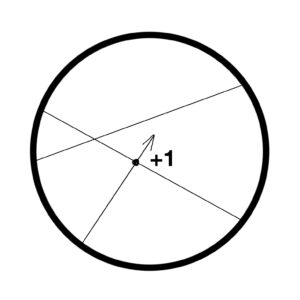
Therefore, the total number of parts at the end will be:
1 + the number of the chords + the number of the intersections of the chords
Each chord is determined by its 2 endpoints and therefore the number of chords is N(N-1)/2.
Each intersection is determined by the 4 endpoints of the two intersecting chords and therefore the number of intersections is N(N-1)(N-2)(N-3)/4!.
Which of the following is the odd one out and why?
The answer is Mars, since it spins counter-clockwise. All the other objects spin (or contain elements that spin) clockwise.
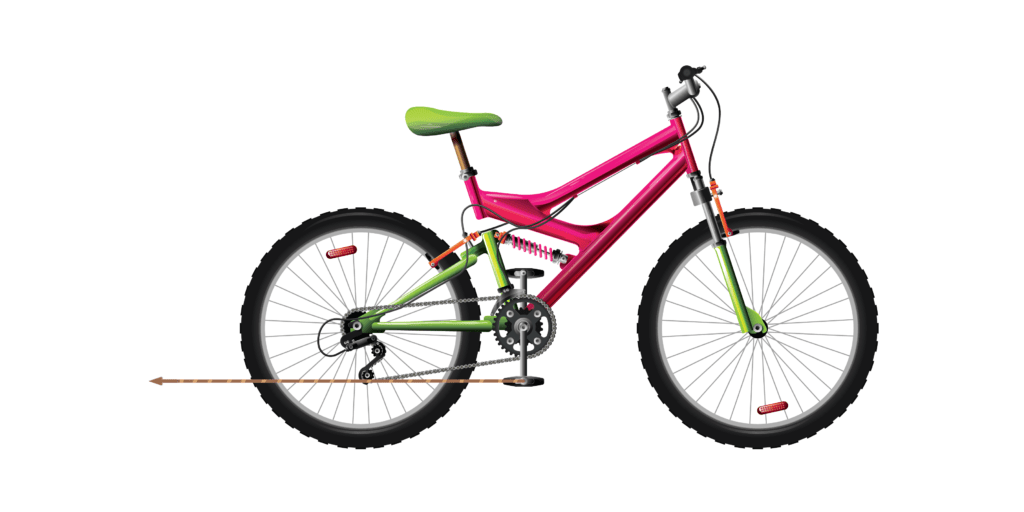
If you pull straight back on a pedal of a bicycle when it is at its lowest position, will the bicycle move forward or backward?
The surprising answer is that (usually) the bicycle will move backward.
When a bicycle moves forward, the trajectory its pedal traces with respect to the ground is called a trochoid. Depending on the selected gear of the bicycle, that trochoid could be:



Since we are fixed with respect to the ground, by pulling the pedal backward, we are causing it to move leftward along the trochoid and therefore the bicycle will be moving backward. We note that despite that, the pedal will be moving forward with respect to the bicycle (but not with respect to the ground).
You can see a visual explanation of this puzzle in the video below.

For this puzzle/game, you will need to find a group of friends, preferably 5 or more. The premise is that you will go together on a vacation but each of you can bring only specific items there. The rules regarding which items can be brought and which not are known by one of the players and the other ones are trying to guess them.
In the exchange below, George is the one organizing the trip and the one who knows which items the rest are allowed to bring.
GEORGE: I will take my guitar with me. What do you want to take?
SAM: Can I take an umbrella with me?
GEORGE: No, you cannot take an umbrella, but you can take some sunscreen.
HELLEN: Can I take a scarf with me?
GEORGE: No, you cannot take a scarf, but you can take a hat.
MONICA: Can I take a dress with me?
GEORGE: No, you cannot take a dress, but you can take some makeup.
Can you guess what the rules of the game are?
Everyone is allowed to take with themselves only items whose first letter is the same as the first letter of their names. Thus, George can take a Guitar, Sam can take Sunscreen, Hellen can take a Hat, and Monica can take Makeup.
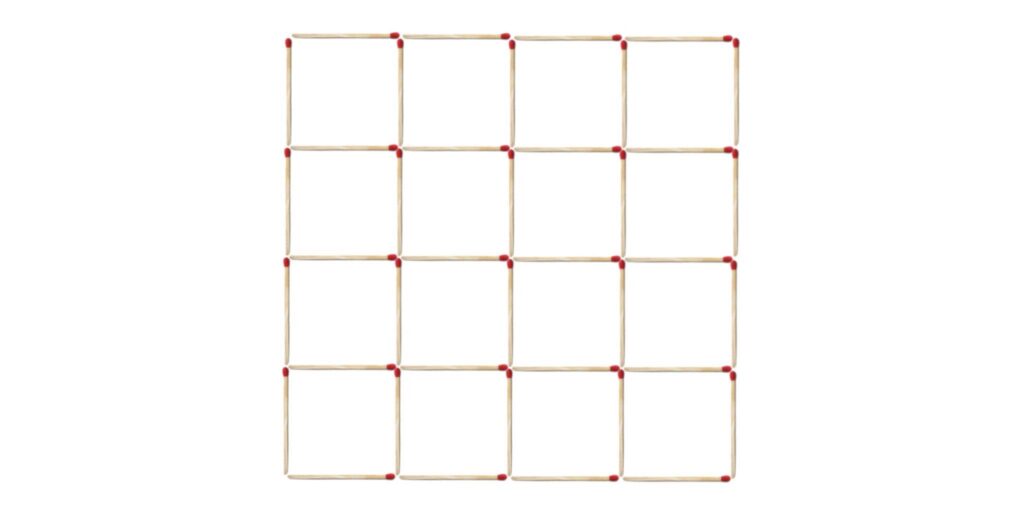
How many matchsticks do you need to remove so that no squares of any size remain?
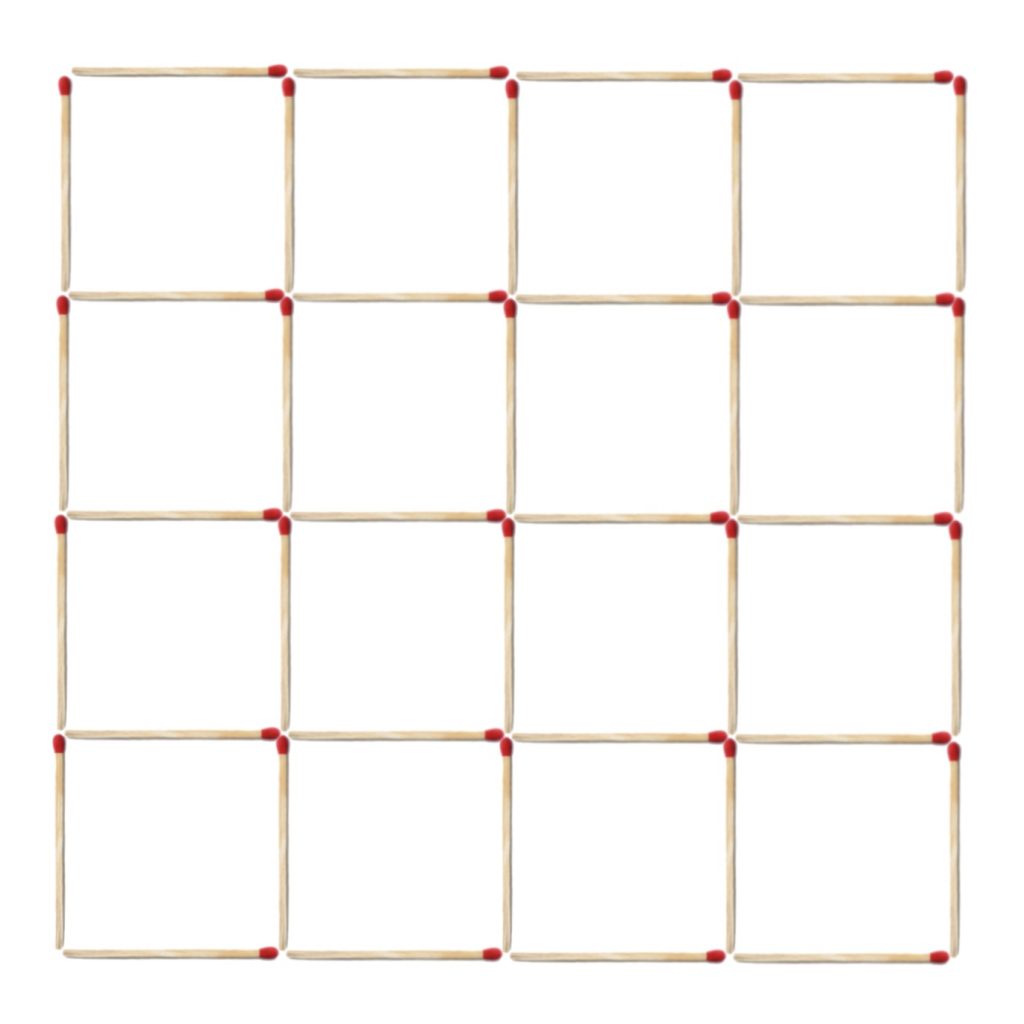
Nine matchsticks are enough, as seen from the solution below.
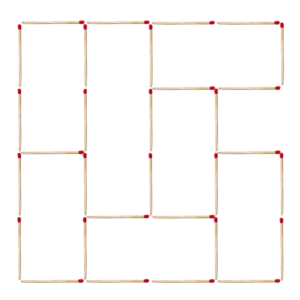
To see that eight matchsticks are not enough, notice that removing an inner matchstick reduces the number of 1×1 squares at most by 2. Since there are 16 such small squares, in order to get rid of them all, we need to remove only inner matchsticks. However, in this case, the large 4×4 square will remain.
Which is the least spoken language in the world?
The answer is THE SIGN LANGUAGE.
Please confirm you want to block this member.
You will no longer be able to:
Please allow a few minutes for this process to complete.